
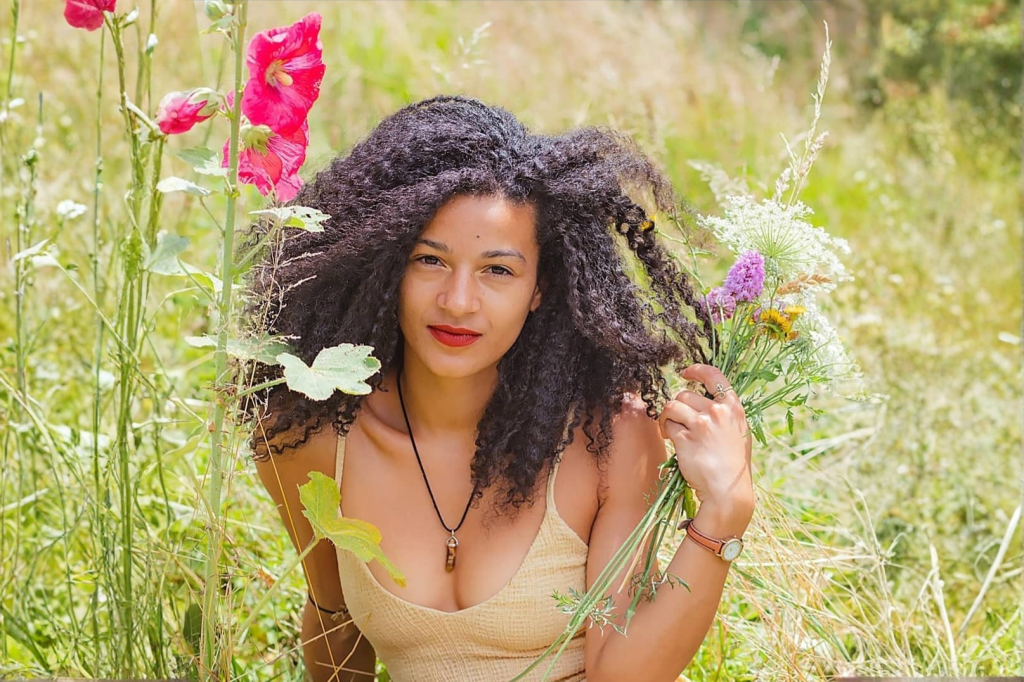
Afrofuturist, feminist painter, Kida Wolfskin, creates out of the overflow of her connection to nature and her own roots. ”My art is really about putting the human and the environment together because we are one thing. People want to dissociate from it—there is me and there is nature—but you can’t do that because we’re part of nature.”
Wolfskin seeks to emphasize this connection particularly with women. “Everytime I draw different scenes, the energy always matches with the woman. I want people to feel like it’s just one entity and to put the woman in a place where she is authentic and valuable and she deserves to be here. She’s part of planet Earth and she’s an element that you can’t remove.” This shines through in her artwork, which consists mainly of portraits of Black women and often includes elements of plants and animals. The women exist unapologetically as Wolfskin allows their body, hair, and face to take up space on the page and create balance within their environment.
Some of Wolfskin’s biggest artistic inspirations come from the Lascaux cave paintings and Egyptian drawings—artwork she describes as primal. This influence is evident in many of her paintings, which present clear lines and blocks of color and whose subjects appear mostly two-dimensional in nature, with all of the most recognizable features included regardless of the orientation of the body.
One such painting called “Mekdes” contains a simple backdrop of cloud-spotted sky and land. Two women kneel on podiums on either side of the canvas and face each other with their hands held up. The figures are drawn in a frontal view where we see the entirety of both of their faces and the full length of their limbs and torsos. On the left side a pitcher is being poured above the head of the woman, while on the other, the woman balances and holds the form of another woman atop her head. Between the women, a blue snake curls back and forth. Each element is outlined in black ink. Of this work, Wolfskin writes on her instagram (translated from French): “Homage to generational transmission. Homage to rituals and to women of the past, present, and future.”
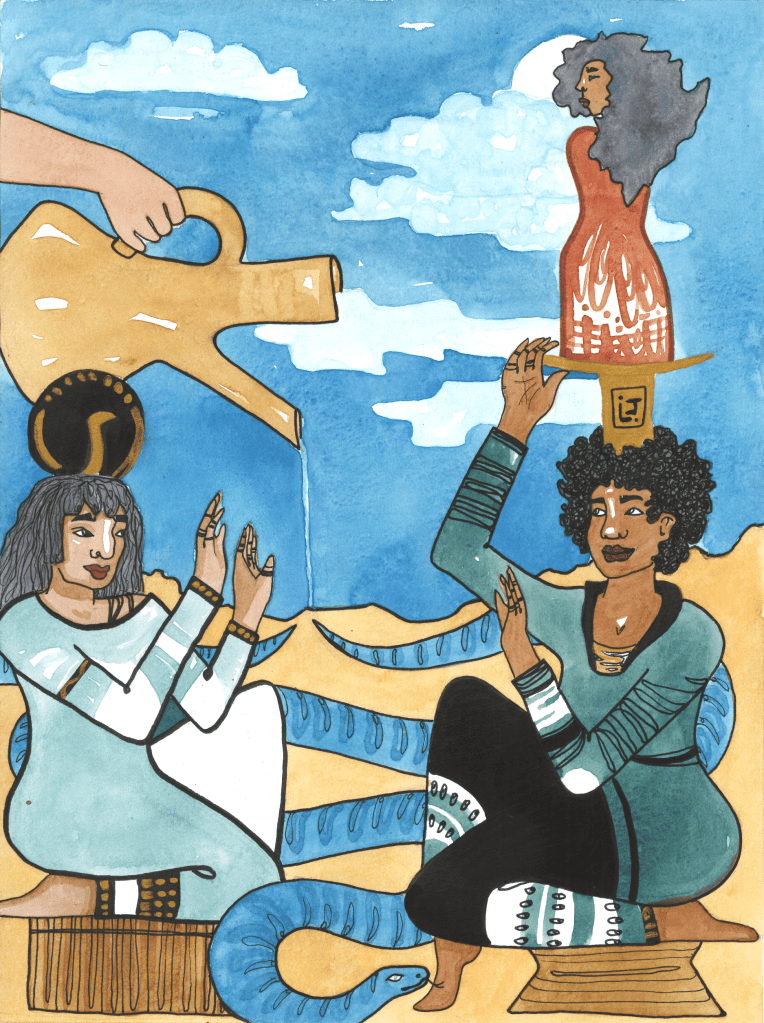
Further illuminating the meaning of the piece, Wolfskin shares that the vase is pouring out both clouds and water, with the water flowing and transforming into the snakes, which appear as rivers, representing life and cycles. As for the three women in the painting, the woman on the left represents, “the mystic past. She knows secrets. She knows ancient rituals.” This woman holds knowledge that she is transmitting. The figure held atop on the right represents the present. She’s looking back to the past while staying firm in her values. Her hair also resembles the shape of Africa—holding the memory of the earth. Elevating the women of the present is the woman of the future. “She keeps the present in her mind and still recognizes the past as a path for her heart. She’s grateful for where she came from and ready for the next chapters.”
The name Mekdes comes from a friend of Wolfskin, who unintentionally resembles the woman of the future. It is also an Ethiopian name meaning holy place or altar. The piece speaks strongly to Wolfskin’s reverence for nature, ancestral wisdom, and the Black feminine body and voice
As the daughter of a white French man and a Black mother from the French Caribbean island of Guadeloupe, Wolfskin has grown into this mix of culture and heritage. “I think my inspiration comes from all over the world—especially from my Black roots—but also from my curiosity for everything the world has to offer..” Raised in the French alps, she has always had the desire to connect with the trees, dirt, creatures, and mountains surrounding her. She also connects deeply with her Black roots through art, music, literature and most notedly, her relationship with her mother. Her mother has passed down feminist values to Wolfskin and her siblings, instilling Wolfskin with the importance of kindness and the knowledge that her voice and body matter. It was also her mother that encouraged creativity through music and art within the home during her childhood.
One of the strongest literary influences for Wolfskin is the French Guadeloupian writer Maryse Condé and her book “Moi, Tituba, Sorcière” (English translation – “I, Tituba, Black Witch of Salem”). The book, set in the 17th century, follows the story of Tituba, a biracial girl born on the island of Barbados following the rape of her Black enslaved mother by a white man. Tituba learns to connect with the land and draw power from it as the story eventually takes her to Salem, Massachusetts. Wolfskin strongly identified with this character she describes as “full of light and darkness.”
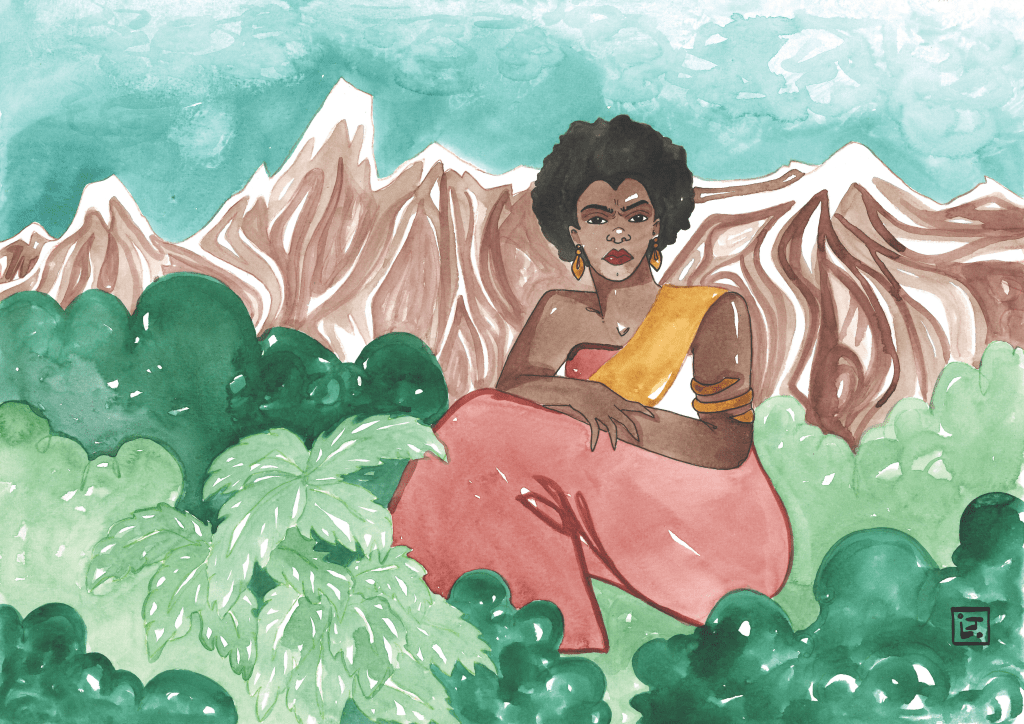
Growing up in France, Wolfskin is disappointed that she was not exposed in school to the work of Condé or other writers that speak truthfully about the harmful history of colonization, enslavement, and the intersection of suffering historically determined by gender, skin color, economic status, and other factors. It was powerful for Wolfskin to see herself represented in the pages of Condé’s writing and it inspired her to create a painting she titled after the book. She is further influenced by the words of women such as Alice Walker, Toni Morrison, Maya Angelou, Angela Davis, bell hooks, and many others.
Though she was always drawn to art and creativity, it wasn’t until confinement during the 2020 coronavirus pandemic that Wolfskin started drawing consistently. At first, she only used the materials she already had at home without purchasing anything new — paper, pencils, pens, and markers. With no formal training or lessons, she was very shy to share her artwork. Later, her mother offered her a set of watercolor paints, which allowed her to discover a love for painting.
With some encouragement from her family and boyfriend, Wolfskin had her first art exhibition at Café Foch in Grenoble in 2022. Now, she has had numerous exhibitions around Grenoble and has found confidence in her voice and artwork. “I realize that my work matters because I represent things that other people don’t, in a way that other people won’t. My art is just an extension of what I see and what I want to be seen. I hope it helps people by the beauty, simplicity and magic of it all.”
Wolfskin encourages others to tap into their own creativity by making art, as she did, with whatever they have on hand. She also teaches drawing workshops at concept store and café, Club Janine, in Grenoble. These workshops are for people of any skill level wanting to explore drawing and making art. The message Wolfskin most wants to share is that, “creativity is for everyone. Art is everywhere. Don’t pressure yourself because whatever you create is art.”
You can follow Kida Wolfskin on Instagram where she shares many of her paintings and videos of her artistic process. She has both original paintings and prints for sale and is also open to commissioned work.
 Her Times