
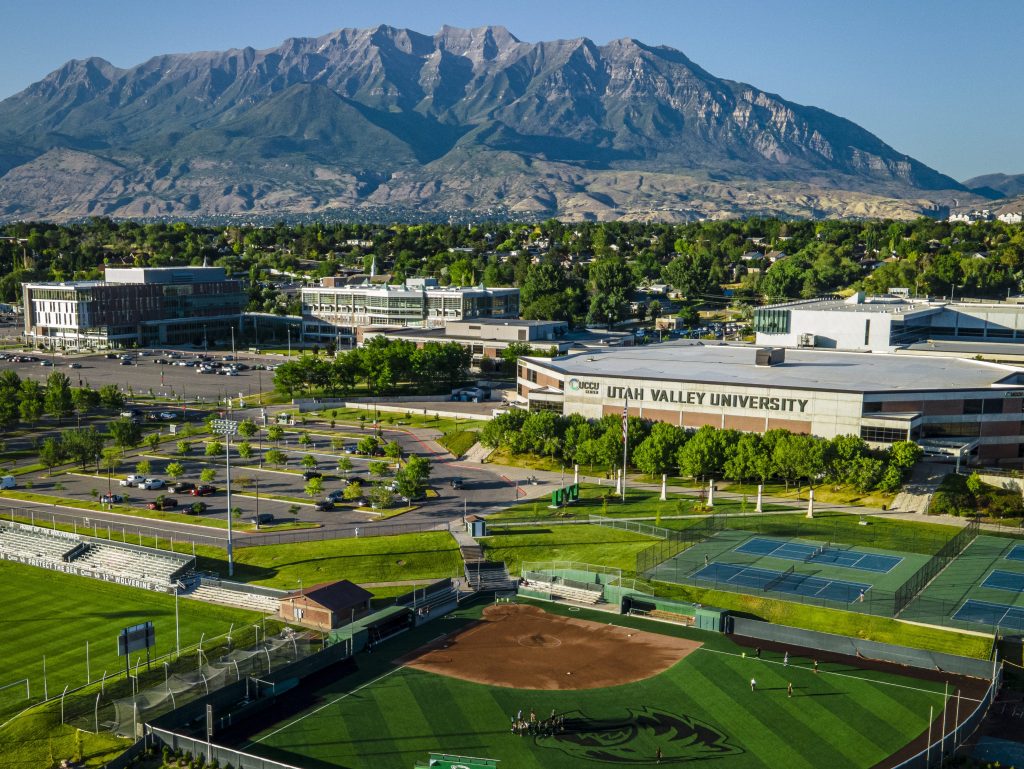
Photo credit: UVU Marketing & Communications
Orem, Utah is ordinarily a sleepy place far beyond the periphery of American Politics. Yet, on September 10, 2025 it became the epicenter of an earthquake that rocked the political soul of the nation. I am talking, of course, about the murder of far-right influencer, Charlie Kirk which took place at Utah Valley University.
Utah Valley University was, until recently, unknown by most outside of Utah. As for myself, I have been well acquainted with the University for three years as the place of my employment. Fortunately, I was working from home on the day of the incident when I saw the story break on the internet. I recognized the courtyard as one I have walked past at least a hundred times; my shared office happens to be right next to that courtyard.
I did not know who Charlie Kirk was and my first thought was for my coworkers whom I had talked to over Zoom not three hours before. We had laughed over a coworker’s puppy jumping into view of their webcam and talked about our pets for a while before signing off. All had been normal. After texting those in the office to make sure they were safe, I then made the mistake of deep-diving into the whirlwind of blame and anger that had seized upon social media.
It was there that I first learned who Charlie Kirk was and what he stood for. His ideology was the exact opposite of every belief I personally ascribe to. Yet, rather than focusing on his contentious career, I would instead like to focus on the damage done to the national community. In the ensuing days, I witnessed President Trump utter threats of violence on opposing parties. I observed Laura Loomer categorize the left as “a national security threat.” Added upon this were conspiracy theories, speculation, and blame – all hostile, all serving to split an already dramatically-polarized population of ordinary citizens.
Yet, in contrast to the aggressive rhetoric of national voices, the community of Orem has found a quiet strength in their local leadership, who delivered messages of peace and unity. If there is any moral to this story, it is found in the official statements of community leaders like Astrid Tuminez, President of the University. Who pointed out that:
“This attack was not just on an individual, but on the spirit of free expression, civil discourse, and intellectual inquiry that sits at the very foundation of our University.”
It must be recognized that President Tuminez’s political leanings are unknown and will not be speculated upon or assumed here. All I can say is that when a conservative student association approached her about inviting Charlie Kirk to speak on campus, she graciously allowed it with the same spirit of free expression that she demonstrated in her official statement. President Tuminez and I are of the same mind in this instance. Institutions of higher education serve vital functions to their communities as sanctuaries of intellectualism, open-mindedness, and social cooperation. The violence that was displayed on Wednesday directly violated those ideals.
President Tuminez was not the only voice of reason in the midst of national outrage. The Sunday after the incident, an assembly of community members – mostly students or employees at Utah Valley University – gathered in a local church just across the street from campus. Here, a statement was read from one of Utah’s religious leaders:
“We affirm our repeated calls to seek peace and unity despite our differences… that hate is wrong and that human life is sacred. We urge all to reject violence and instead build understanding. …we must treat one another with more dignity, compassion, and respect. As we mourn with those who have experienced loss and care for those living in fear or conflict, we call upon people everywhere to build communities of greater kindness and love.”
After reading this statement, the floor was then open for discussion. Attendants hailed from all across the political spectrum. Yet, great maturity was demonstrated by the attendees in that political parties were completely omitted from the conversation. Instead, the main concern was for those who had been on campus at the time, and were still deeply traumatized by the incident, for the students who had run and hidden when all they knew was that there was a shooter on campus. For the employees like my coworkers, had been escorted out by officers with guns. The general consensus of the evening was that in these difficult times, we must anchor ourselves in community and connection with our neighbors. While angry voices outside of that circle called for retaliation and violence, it was incredible to witness how the community most affected was able to draw closer together in quiet camaraderie.
It is camaraderie that is the hero of this story, if any hero deserves to be recognized. There is still a decent amount of healing to be done. My coworkers are traumatized, and it doesn’t help that sight-seers still swarm campus every day just to see the scene of the crime. Their cars block the parking lots, and their tributes of flags and paper messages litter the ground. Meanwhile, staff and students are just trying to get back to normal. I have learned that political violence does not just make victims of the dead. It victimizes entire communities.
So, in following the example of Utah’s community leaders, I remind all that political violence has no place in an enlightened, democratic society. Such is the tool of a more primitive era, and is best left behind. This principle applies all the more strongly to those we most disagree with. Bullying, retaliation, and abuse only fuel hostility and thereby deeply damages any cause such tactics might be employed in the name of. Right now, our nation needs not leaders of argument and rhetoric, but leaders of kindness, empathy, and charity. It is these that will carry our communities forward on a local and global scale.
 Her Times